

CDR Lectures at University of Mannheim
17 February 2026
With a six-part lecture series at the University of Mannheim, the German Association for negative Emissions (DVNE) is systematically integrating Carbon Dioxide Removal (CDR) into academic education for the first time.
The lecture series is aimed at Master’s students and covers the topic comprehensively: from scientific foundations and policy frameworks to economic and corporate perspectives. More than 150 students have registered for the voluntary evening course — a clear indication of the growing interest in carbon dioxide removal.
Overview of the CDR Lecture Series
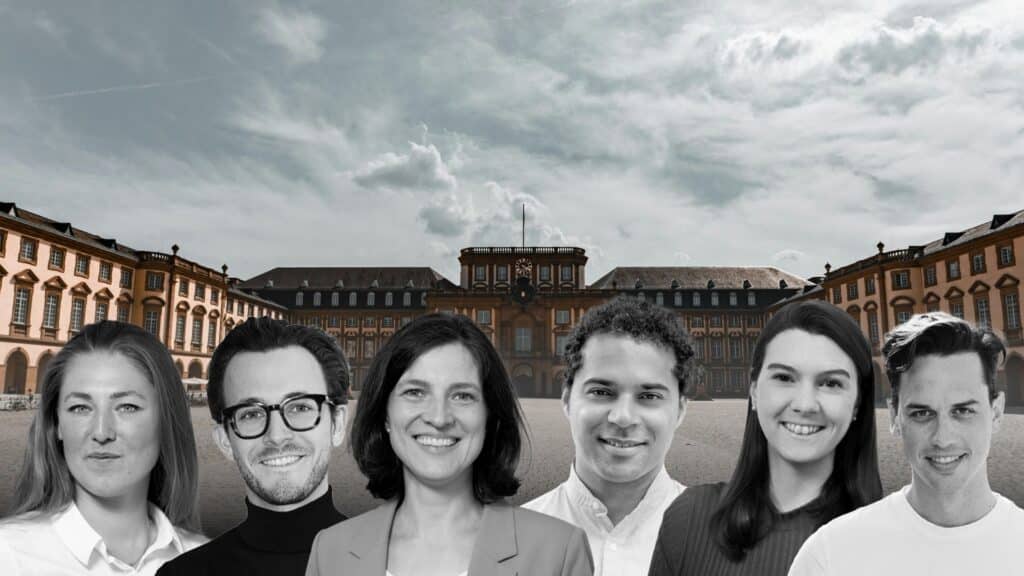
The lecture series takes place from 17:15–18:45 at the University of Mannheim (B6, Hall O151).
12 February 2026
Introduction to Carbon Removal – Context, Science & Technologies
Speaker: Carolin Güthenke
(DVNE Board Member, Co-Chair German Biochar e.V.)
26 February 2026
The Carbon Removal Ecosystem & Policy Landscape
Speaker: Nadine Saken-Walsh
(Policy Manager, DVNE)
5 March 2026
Carbon Removal Markets – Supply, Demand & Trading
Speaker: Magnus Drewelies
(CEO, CEEZER; DVNE Board Member)
12 March 2026
Financing & Investing in Carbon Removal – Venture, Philanthropy & Capital Markets
Speaker: Lisa Mangertseder
(Investor, Carbon Removal Partners; DVNE Board Member)
19 March 2026
Economics of Carbon Removal – Costs, Incentives & Impact
Speaker: Robin Bierganz
(Project Leader, Boston Consulting Group)
26 March 2026
Business Case for Carbon Removal – Corporate Participation & Strategy
Speaker: Aaron Neuville
(Partner, EY; DVNE Board Member)
The lecture series concludes with an exam.
Kick-off: Scientific Foundations and Climate Policy Necessity

The opening lecture was delivered by Carolin Güthenke. Her session focused on:
- the global carbon cycle,
- the target architecture of “net zero” and “net negative”,
- an overview of CDR methods,
- economic opportunities for Germany,
- and key scaling challenges.
Curious. Focused. Critical.
Reflecting on the first session, Carolin Güthenke stated: “With this lecture series, we aim to deepen the understanding of why ‘net zero’ and ‘net negative’ require carbon dioxide removal. The high registration numbers, the strong attendance, and the thoughtful questions from students truly impressed me.”
Photo of the University building: Justus Menke