
Protect the climate.
Seize the opportunity.




FAQ
Carbon dioxide (CO2) in the atmosphere is the main cause of global warming and climate change. The higher the concentration of CO2 in the atmosphere, the stronger the greenhouse effect and global warming.
The CO2 emissions that we release into the atmosphere increase this concentration. These emissions therefore appear in the positive column of the balance sheet. In contrast, negative emissions describe carbon dioxide removed from the atmosphere. The CO2 that is actively removed reduces the concentration in the atmosphere and therefore appears in the negative column of the balance sheet. Negative emissions are thus created through what is known as carbon dioxide removal (CDR).
In addition to carbon dioxide, there are other greenhouse gases such as methane and nitrous oxide. Negative emissions are also needed for these gases, i.e. solutions for removing them from the atmosphere.
In order to mitigate the dangers of climate change and safeguard a liveable future, Germany wants to become climate neutral by 2045. By 2045, the aim is for there to be a balance between the emissions released into the atmosphere (positive) and those actively removed from the atmosphere (negative). This means that positive and negative emissions neutralise each other in terms of accounting. This is therefore also referred to as the net-zero target.
Achieving climate neutrality, or more precisely net-zero emissions, is not possible without carbon dioxide removal (CDR). This is not an assessment or opinion, but an indisputable fact. CDR is used in all scenarios modelled by the IPCC (Intergovernmental Panel on Climate Change) for global warming of 2°C or less.
It is important to stress that CDR cannot and should not replace drastic emissions reductions, but rather complement them. Carbon dioxide removal is therefore not a pretext for avoiding real change and the phase-out of fossil fuels. CDR is an indispensable part of the transformation.
There are a variety of CDR methods, some of which differ greatly in terms of their stage of development, scalability and risk factors. Smart governance is therefore a crucial factor. In order not to lose any time, it is important that all CDR methods are first researched, developed and promoted.
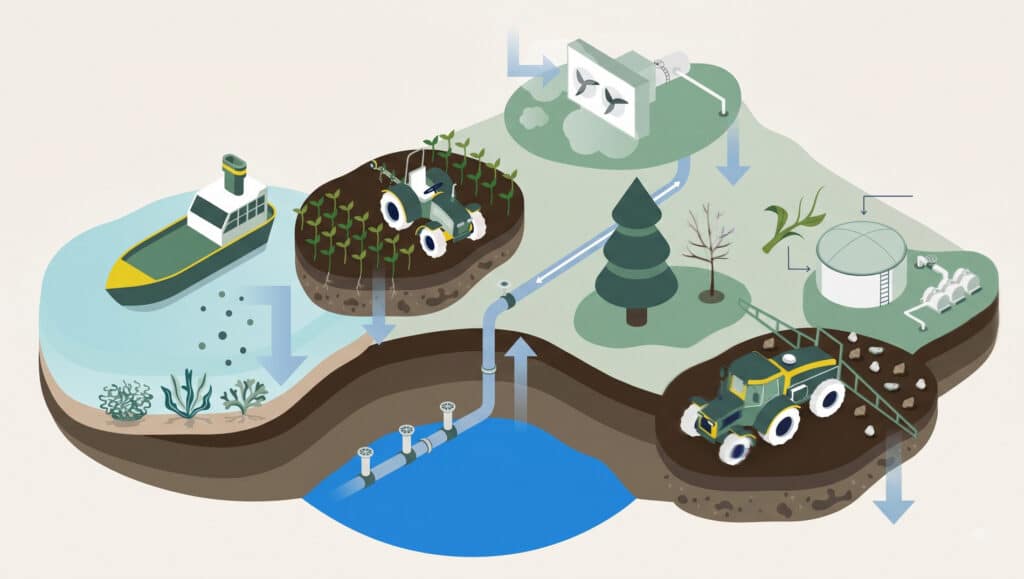
CO2 can be actively removed from the atmosphere using various methods. In addition to natural methods such as reforestation and soil carbon sequestration, there are various technical solutions. These include, for example, direct air capture with subsequent storage (DACCS), the production of bioenergy with capture and storage (BECCS), enhanced weathering and the production of biochar with biochar carbon removal.