

CDR Policy: LNe and ANK 2.0 in Motion
19 August 2026
Germany’s carbon removal industry has been waiting for the Long-Term Strategy on Negative Emissions (LNe) for some time. The strategy is now expected to be adopted by the Federal Cabinet by the end of September. At the same time, the ministry has submitted a second key initiative for CO₂ removals, the Natural Climate Action Programme 2.0 (ANK 2.0), for stakeholder consultation.
This means that two important policy frameworks are now being advanced for the two pillars of CO₂ removal in Germany. While the LNe is intended in particular to create the framework for scaling novel or technological CO₂ removals, ANK 2.0 addresses natural carbon sinks such as forests, peatlands and soils. Germany needs both to achieve its long-term climate targets. We explain what is currently moving – and what it means for Carbon Dioxide Removal (CDR) in Germany.
Long-Term Strategy on Negative Emissions: Long awaited, now nearing completion
The LNe is the Federal Government’s central strategic initiative for scaling novel CO₂ removals. Work on the strategy began under the previous Federal Government. In February 2024, the so-called key points paper was presented. The strategy is intended to create the framework conditions for an efficient, sustainable and climate-effective scale-up of CO₂ removals. To this end, future demand was modelled based on expected residual emissions in Germany, among other things, and various removal methods were scientifically assessed.
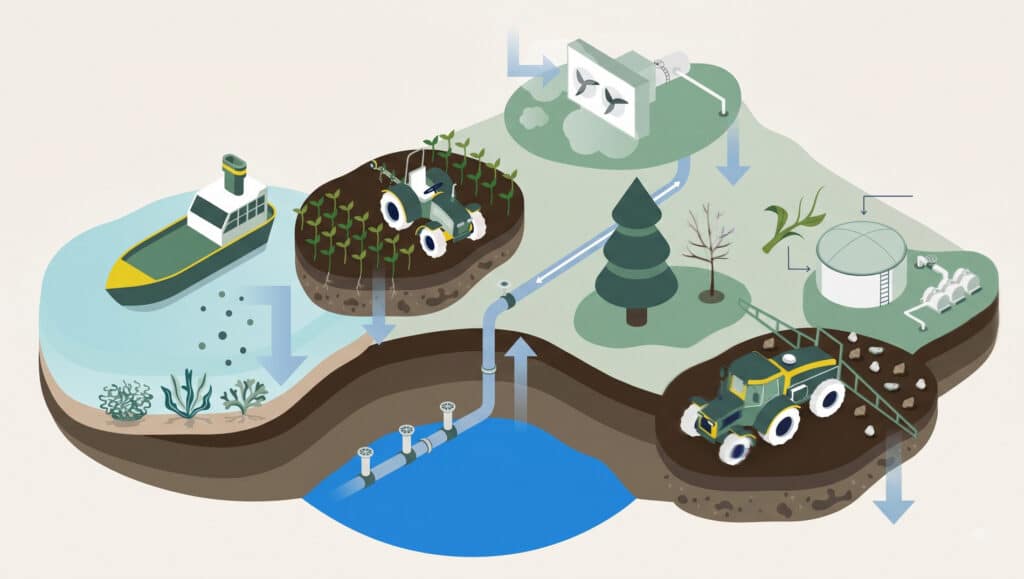
The basic idea is clear: Reducing greenhouse gas emissions has the highest priority on the path to climate neutrality. However, particularly in industry and agriculture, emissions will remain in the long term that cannot be completely avoided. To balance these residual emissions and achieve net-negative emissions after 2050, Germany must additionally remove CO₂ from the atmosphere and store it over the long term.
Following the change of government, work on the strategy continued. The German Energy Agency (dena) is supporting the BMUKN in finalising the LNe and, beyond that, in establishing suitable framework conditions for market scale-up through 2029. This includes developing funding instruments, shaping the legal framework and supporting the establishment of an investment support programme for CO₂ removal certificates. Things are now moving: The LNe is expected to be adopted by the Cabinet by the end of September 2026.
The German market is growing
A recent market analysis by dena shows that the LNe is no longer merely a strategy for the distant future. It identifies around 150 German companies along the CDR value chain as well as 61 existing or planned projects in Germany. Annual (pre-)sales by German CDR providers increased from around 25,000 tonnes in 2024 to around 197,000 tonnes in 2025.
German companies are already proving competitive in international tenders. At the same time, the domestic market remains small. Some German providers are developing their projects abroad – partly due to lower energy prices or more favourable regulatory conditions. This also makes the LNe relevant from an industrial policy perspective: Germany has companies, technologies and know-how. The key now is to create the conditions under which a scalable market can develop in Germany.
In addition to clear rules, this requires above all reliable demand and financing. The integration of permanent CO₂ removals into the European Emissions Trading System will play a decisive role in this.
The second pillar: ANK 2.0 for natural sinks
Alongside the LNe, there is now also movement on the second pillar of CO₂ removal. At the beginning of August, the BMUKN submitted the draft Natural Climate Action Programme 2.0 for stakeholder consultation.
The need for action is considerable. Germany is currently falling significantly short of its climate targets in the land use sector (LULUCF). For 2030, a gap of around 50 million tonnes of CO₂ equivalents is expected compared with the statutory sink target. Many forests have lost significant sink capacity due to drought, heat and pest damage. At the same time, drained peatlands cause high greenhouse gas emissions.
With ANK 2.0, the BMUKN aims to counteract this trend. The draft includes measures for peatlands, forests, mineral soils, coasts and seas, as well as the harvested wood products carbon pool, among other areas. Overall, the proposed measures are intended to achieve an additional greenhouse gas impact of 13.5 million tonnes of CO₂ equivalents in 2030, 60 million tonnes in 2040 and 77 million tonnes in 2045. This would not close the existing gap in the short term, but natural sinks are intended to be significantly strengthened again over the long term.
The need for action is particularly great for peatlands. Drained peatlands currently cause substantial greenhouse gas emissions. Under ANK 2.0, their annual greenhouse gas balance is to be improved by 2.5 million tonnes of CO₂ equivalents by 2030 and by 20 million tonnes by 2040. Funding programmes are intended, among other things, to support farmers in transitioning from dry to wet forms of land use. Around €1.1 billion is earmarked for natural climate action in the Climate and Transformation Fund in 2027.
The draft is currently undergoing stakeholder consultation and may therefore still change. Some measures are also politically contested – particularly where climate and nature conservation conflict with existing agricultural and forestry land uses.
Natural climate action is not automatically CO₂ removal
From the DVNE’s perspective, one distinction is particularly important when assessing ANK 2.0: Protecting an existing carbon store, avoiding additional emissions and actually removing CO₂ from the atmosphere are not the same thing.
All three make an important contribution to climate action. For negative emissions, however, what matters is how much additional CO₂ is actually removed from the atmosphere and stored over the long term. The DVNE therefore advocates better measurement and accounting of the actual CO₂ sink performance of funded measures and targeted support for this performance.
This also includes closer alignment between ANK and the European Carbon Removal and Carbon Farming Certification Framework (CRCF). In the future, funded measures should be compatible with European standards for quantification, monitoring, additionality and permanence. At the same time, natural carbon sinks require long-term planning certainty: Forest conversion, soil carbon build-up or peatland restoration cannot be achieved within individual short-term funding periods, but take decades.
“CDR actors need an economic incentive to remove CO₂ from the atmosphere and store it over the long term. In the carbon removal industry, there is one hard currency: the tonne of CO₂ actually removed. This principle should also be more firmly embedded in ANK by putting a price on measurable natural CO₂ removals and providing targeted support for them.”
Nadine Saken-Walsh, Policy Manager, DVNE
Advisory services for natural climate action
Since October 2023, the Natural Climate Action Competence Centre (KNK) has coordinated advisory services for stakeholders and serves as a nationwide contact point for questions on measures and funding opportunities. It supports the development of projects. More information is available here.
Technological and natural: Germany needs both
LNe and ANK 2.0 address different forms of CO₂ removal, but they belong together from a climate policy perspective. In its market analysis, dena also concludes that natural and novel CO₂ removals need to be developed in a complementary manner. Neither pillar can deliver the necessary CO₂ removal on its own.
For novel methods such as DACCS, BECCS, biochar or enhanced weathering, the task now is to develop a scalable market from research, pilot projects and initial sales. For natural sinks, the task is to halt their decline, rebuild their sink capacity and make additional CO₂ removals reliably measurable.
The same principle applies to both: Emissions reductions have priority. CO₂ removal complements ambitious climate action; it does not replace it.
The coming weeks will be decisive
After years of preparation, German CO₂ removal policy could now be entering a new phase. The stakeholder consultation on ANK 2.0 ran until 20 August. According to the BMUKN, the Long-Term Strategy on Negative Emissions is expected to be adopted by the Cabinet by the end of September.
What happens afterwards will be crucial. The LNe must result in a reliable framework for scaling the market for novel CO₂ removals. ANK 2.0 must strengthen natural sinks over the long term and make their actual CO₂ removal more measurable and easier to support.